Delicacies from Kumamoto

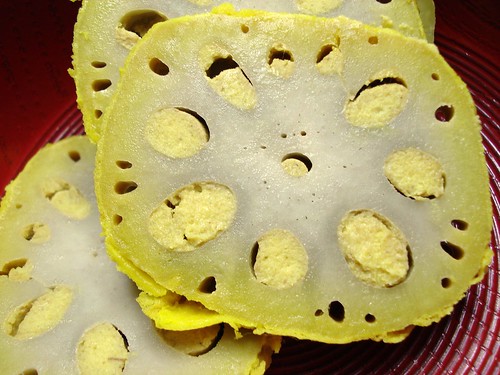
As I said in my last posting, I was travelling in Kansai and Kyushu in the last weeks and of course the local cuisines were (beside climbing a volcano, swimming at a wonderful beach (although I quite often heard I should forget about beaches in Japan, except for I go as far as Okinawa..), strolling through bamboo groves and paddy fields etc) the highlights of my vacation. Especially in Kyoto I had spectacular meals, but today I start with something small but not less delicious. Like everywhere in Japan omiyage (souvenirs) are a big thing in Kumamoto, the lovely city on western Kyushu. And also like everywhere in Japan most of these gifts are edible. Beside all kinds of the ubiquitous sweets filled with sweet beanjam, you can also get quite different specialities in Kumamoto, that I've really never saw somewhere else before. One is karashi renkon: lotus roots (=renkon) generously filled with a mixture of mustard (=karashi) and miso and baked covered with a batter that is also made with mustard. You can buy big pieces of karashi renkon in every supermarket or omiyage shop and cut slices of it that look like a fantastic yellow-beige flower. However, don't trust the harmless looks of it! It is hot! I never had more intensive mustards than Japanese mustards! Karashi renkon feels tangy on your tongue, tickles your nose and can bring tears to your eyes and the sweat to your forehead - but in a wonderful way! It feels like cleaning your pores and refreshing your mind, especially on a hot summerday with more than 35°C, like the days I had in Kumamoto.
The lotus root itself is crisp and tingly and like the thin batter, it only does very little to lessen the sparkling feeling of the smooth mustard-miso-paste that is filled in its naturals holes. You eat this goody just like this with a beer or some other drink, if you can eat hot stuff. If you are not that strong, you can also have it with rice and other vegetables, tofu or whatever you like. I even made myself sandwiches with slices of karashii renkon on it! It tasted great, but I guess people from Kumamoto might be horror-stricken to see this westernized version to eat their wonderful traditional delicacy - so better try this only at home when nobody watches. And please don't tell anybody that it was my idea ;)
Another tidbit from Kumamoto is filled with red bean paste, but it is so different to most other anko-sweets that I want to present it here.
It is ikinari dango, a slightly sweet dumpling stuffed with potato and, as I said, a little anko. It is steamed, so that the "pastry" that covers the potato-anko-filling still has a very dough-like texture, what I like a lot. And unlike many other Japanese sweets the anko does not dominate the taste of the whole dumpling. It was not that much inside and it was not that high on sugar so that the earthy potato flavour comes to the fore. I bought it at a nice little shop where they sold it still warm.. very delicous!
Another speciality from Kumamoto is a kind of stew with all kinds of vegetables and something in it that appears to be somewhat between noodle and dumpling, reminding me a bit of Spätzle. But to be honest: temperatures were to high to eat a steaming hot pot of stew, so I have to admit I did not taste this dish. It looked very good however and if I ever come to Kumamoto during a cooler season I will definitly try it.
Yet another delicacy Kumamoto is famous for I will surely never ever try: basashi - raw horse meat sashimi! There even is a local basashi-themed Hello Kitty phone strap [click]... well, well...

Tsuruhan


A few days ago I was tagged by Vegetablej for writing a meme "8 Random Things about Myself". Sorry that I haven't written anything yet, I was quite busy preparing everything for some travelling I will do in the next two weeks - so I guess this will have to wait until I am back. On my trip I will meet my flickr-friend and co-foodie Angie and I am quite sure that the two of us will discover a lot of wonderful vegetarian food in Nagoya, Kyoto and Kobe together! A detailed report hopefully with lots of recommendations will follow in the next weeks. Afterwards I will travel further south to Kumamoto and Hiroshima - hoping that the local cuisine there has some nice things to offer for non-animal-eaters :)
I am so much looking forward to conquer some new territories on my personal travel-map, and of course it will not only be sightseeing but also lots of "foodseeing" (and tasting!!) which is always a major point of interest during my travels (actually not only during my travels.. uhuhu). So stay tuned for my food-travel-diary in the near future.

Kyoto is the only place on my route that I have visited before and in anticipation of the fantastic Kyoto-ryôri, a cuisine with lots of vegetables and famous for its tofu dishes, I will recommend a Kyoto-style restaurant in Tokyo today.
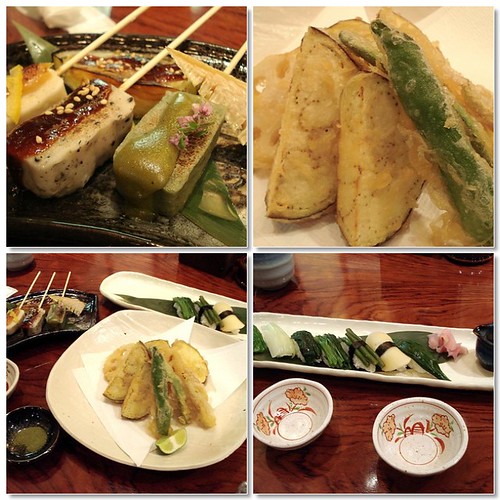
The place is called Tsuruhan and it is located in the stunning Tokyo International Forum, a huge modern building, with impressing architecture close to Yurakucho Stn. I have been there some weeks ago and the food was of the highest quality and best taste to be imagined. I shared some dishes with a friend - the best way to get to taste as many things on the menu as possible, and every single one of them was perfect. We had wonderful vegetable sushi, topped with fresh and lush greens, with a texture that couldn't be more right. The vegetables had still all of their juice and the rice was a dream!
Next a plate of yasai-tempura, deep fried vegetables in a light batter, was served and again it was just to the point. Deep frying always bears the risk that the food looses all its flavour, gets soaked with re-re-reused oil and only tastes like that also - but not at Tsuruhan! It was a crunchy delight, not at all greasy, with crisp and juicy vegetables like eggplant, lotusroots, beans, peppers, myoga and satsuma imo, Japanese sweetpotatoes. Those latter ones were admittedly not juicy, but had a sweet and mild taste that is surpassing. The tempura (the name derives from the Portuguese by the way, who introduced this dish to Japan in the 16th century) came with some matcha salt to dip the battered veggies in and fresh lime to squeeze a few drops on the food- heavenly!
And then we had the best thing I ever ate and I don't even know exactly what it was. It was very similar to tofu-dengaku, tofu on wooden sticks glazed with miso-paste, but I think it rather was some special kind of konnyaku (this has nothing to do with alcohol, but is a jelly-like Japanese delicacy made out of a root). Anyway, it was absolutly perfect: soft but firm enough, mild but each with different tastes and spices, with intensively-tasting pastes spreat on top of them: one with yuzu-flavour, so citric-fresh and summerly, one with black and white sesame and a dark fruity-sweet miso(?)paste on it and the third one with mugworth and even little cute flowers. It was as beautiful as delicous - only for that dish, you should really go there!
The restaurant itself is nice to, with a huge plant arrangment in the middle, surrounded by the central counter and some tables around. It is not a big place and we had to wait a while to get seated although we called in advance. So it is better to make a reservation. Prices are ok, not cheap, but not overly expensive too and absolutly fine for the quality they offer. For the mentioned dishes and two bowls of rice (and some tea that was for free) we paid all in all a little over 3000 Yen. It was worth it!!!


Tsuruhan
Tokyo International Forum B1F
[click address to see map]
Marunouchi 3-5-1
Tokyo
Open 11am-11pm daily.

Paritto Fuwatto


Coming from Germany, a country famous for its bread, I have a very distinct idea of how bread has to be like. And as much as I love Japanese bakeries for the pastries, I have to say that the bread usually does not meet my expectations. Most of the bread is just too soft and too sweet. I like bread with a crisp crust and a moist, slightly salty and sour dough. No matter if it is a white or a dark bread - I love both, as long as they are the way I described it. I know, also in Germany there are many big bakery chains and their bread often isn't that way either. But you just have to go to the little bakeries and there you usually still find the good stuff.
And in Japan people are so crazy about food that it just surprises me that something as simple as bread of all things has to be so bland and taste like untoasted toast here! And don't tell me it is because people eat rice all the time - it is not true: bakery products are very popular, too. There are good western bakeries in Japan. French or Scandinavian they mostly want to be. They make wonderful sweet things, pastries, brioche - great!
Sometimes they also offer "German bread" and oftentimes it even looks like bread in Germany, with a brown dough and some grains and seeds on top. It happened a few times that I couldn't withstand trying one again, hoping that this one could be right. That I bought it and as soon as I was out of the bakery opening the bag hastily and covertly (because it is supposed to be rude to eat while walking on the street in Japan) ripping a piece of the bread to try it: and then it is soft and sweet and with a much too fluffy crumb again and the brown colour is just made with malt, not with wholemeal.
Lately however, during one of my countless strolls around Ya-Ne-Sen (Yanaka, Nezu, Sendagi), the downtown area where I live, I came across a tiny little bakery that looked so cute and its products so natural that I just had to go inside and check it out. The painted sign in the entrance that said: おいしいパンとお菓子の店 = "shop for delicious bread (pan - from the portuguese word for bread) and sweets", was also very promising.


To put it blundly, they do not bake "German bread", but this is absolutly fine, I don't search for that! I just search for good tasting bread. In fact I think it is much more interesting when things have a local touch. And in this lovely place called Paritto Fuwatto they do taste great!
No wonder, they are all made freshly in this neat little shop, directly behind the counter. There a very friendly lady is working, who just stops kneading the dough for serving customers. All over the place where she is baking are kabocha (Japanese squash), sweet potatoes and all kind of other good ingrediences used for the breads, rolls, cookies and cakes that pile up in little baskets on a nicely arranged table beside the counter.
It is a little paradise where it is hard to decide what to take: a wholemeal roll with dried fruits or rather an intensivly green one with lots of yomogi (mugwort), a bread with a natural yeast dough and grains or corn, dark short cakes baked with black tea... The shop is so tiny, but the assortment is quite large. And everything I tried so far was sooooo delicious! The bread has a rather light colour and also no crust to speak of, but the dough has a firm texture, is not too dry and not to soft, the crumb is just right and *thanks a lot - it is not sweet! Absolutly luscious are the kabocha rolls, also firm, with a golden colour and slightly moist thanks to the little cubes of the squash inside, which is one of my favourite veggies anyway. Also moist and just sweetend with the fruits was the dried fruit roll, with fruits and nuts - a healthy and filling snack!
The black tea short cakes had an intense tea flavour, just very little sweetness and
with a very nice dry crumb, perfecty matching a cup of milk tea.
Apropos milk tea: for everyone who does not eat eggs or butter Paritto Fuwatto is also a great choice, because on their website they list which of all their products contain these ingrediences (in Japanese only, unfortunatly. But if you are able to read katakana, you will understand most names and behind the names you find the kanji 卵 (tamago) for egg and in katakana バター for butter and o or x (yes or no)- so it is quite easy to understand). And I am sure the lady in the shop is very helpful if you ask her.

I couldn't really find out whether the ingrediences they use derive from organic farming, would be nice if someone whose Japanese is better than mine could check that... but with the special atmosphere in the store, the interior with lots of wood and baskets, the fact that they use brown paper bags instead of vinyl, the emphasis on natural flavours and healthy ingrediences, etc. all that point pretty much in an organic direction. Anyway: it tastes great, that is the most important fact in my opinion. Organic ingrediences would just be a nice bonus.
And has anyone an idea what the name means? パリットフワット Paritto Fuwatto? Seems like a foreign word, because of the use of katakana.. I racked my brains but couldn't think of anything French, English, whatever that sounds similar and all dictionaries I consulted didn't help either... ideas anybody?

Update:
I have been there today again and checked out the yomogipan (bread with looooots of mugwort) and a delicious mikan (tangerine) pastry and both are highly recommendable! The yomogipan has a very refreshing and (at least for me) unusual taste and a fantastic emerald colour! See the top right pic in the new photo mosaic i made.. The tangerine pastry was not too sweet and had plenty of little candied tangerine pieces on top - delicious and such a summerly taste!

The address is:
パリットフワット
東京都文京区千駄木1-19-7
Paritto Fuwatto
Tokyo, Bunkyo-ku, Sendagi 1-19-7
[click address to see map]
about 5 min walk from Sendagi Metro stn, Chiyodaline.

It is open from 9am - 7pm. Closed on mondays.
Tofu Sômen


Today was a bright and sunny summerday! It seems like Tsuyu, the rainy season is finally over! It was very hot outside, but clear and not that humid anymore. It really felt like summer!
So what to eat for dinner on a summer evening? Something light and refreshing! How about Tofu Somen, a new favourite of mine, since I found it in my local supermarket just about two weeks ago. This dish looks like very thin noodles (sômen), but actually these "noodles" are made out of tofu. Traditionally they are eaten chilled with tsuyu-sauce - but this is often made with bonitoflakes(katsuobushi - my nightmare, see my first posting here), so we better take light soysauce and add a little mirin. I also like to put some salad on top- for example tomato-cucumber-nira sprinkled with lemonjuice, sesame oil and black pepper. Although this might not be very authentic, when it is hot I am often starving for salads and fresh, raw vegetables and fruits. I don't care about recipes, I just care about the taste! However, just a little finely chopped myoga and sesame on top of the Tofu Somen also tastes great, for all the purists among you ;)
You can find Tofu Soumen in the refrigarated section of Japanese supermarkets, where it usually is ready-packed with the matching tsuyu-sauce (which might not be vegetarian, as I said before). No cooking is required - just drain the Tofu Somen a little, put them in a bowl and pour the sauce over them. This is just the most perfect thing to eat - fresh, tasty, light, healthy, vegetarian - super easy to prepare for a lazy evening after a hot day!
There are so many wonderful things to find in the huge tofu section of Japanese supermarkets - and most of them are the general vegetarian's friends. You just have to go there and take them home ;)

PS: If you like it a bit more elaborate or are searching for a good idea for the next garden party, try "flowing somen"! Looks like fun!

Monk's Food


Shortly after I arrived in Tokyo I read about Kichijôji, a very pleasant town in the west of Tokyo, with lots of nice bars, restaurants, shops, even some streetart (I couldn't find much though) and the beautiful Inokashira park. Close to the park, I also read, is a very veggie-friendly place called Monk's Food. That had to be checked out of course! So I spent a day roaming through the streets of Kichijôji, looking at the shops, listening to street musicians in the park and watching the turtles relaxing at the pond there.
With an empty stomach I started searching for the mentioned restaurant and found it so fast, I couldn't believe it! Usually I need so long to find something here with Tokyo's weird address "system" (I am not sure about calling it system at all..). It is a very small, oldfashioned and rather dark looking place and weren't there the Monk's Food sign outside, I never expected great vegetarian cuisine. Because I came alone they asked me to sit down at the bar, not upstairs at the tables. This was fine, I had a look at the wall filled with Jazz CD (the restaurant seems to be named after Thelonius Monk) behind the counter and a sign that says that they use mainly organic veggies from farms around Tokyo.
On the menu were three sets: one vegan, one with fish, one with chicken and some smaller dishes, I was to lazy to translate or ask for translation - because I was starving and a set with a variety of dishes just came right. So without knowing what I can expect I took the veggie set and I can say: it was so worth the 1000something yen it cost. First I got free water and a tasty tea and after a short while a great array of dishes came out of the kitchen! There was Genmai (brown rice) sprinkled with kurogoma (black sesame), a miso soup with lots of vegetables like cabbage and carrots etc., cold pickled greens (sorry I don't know, what kind of leaves - but they were good), a generous serving of tofu with grilled and very juicy eggplants topped with grated radish and crisp pak choi and a bowl with sweet potatos and big red beans.
Oooh, it was so! extremely! delicious! I will definitely go there again. Great food: vegan, organic, healthy and so tasty and filling also (not tiny Japanese style portions you might get at other places), good music in the background and the service was fast and friendly, too. Perfect!
And there was just one more customer, so it was not at all crowded there.
By the way: the lady who served me ate one of the sets too - I see this as as a good sign! I know of some people who were working at restaurants and told me they would never eat there themselves... Monk's Food is not such a place, so I can recommend it with all my heart to anyone who happens to be in Kichijôji.

Monk's Food
Kichijôji
1-2-4 Gotenyama
Tokyo
[click address to see map]

Goya


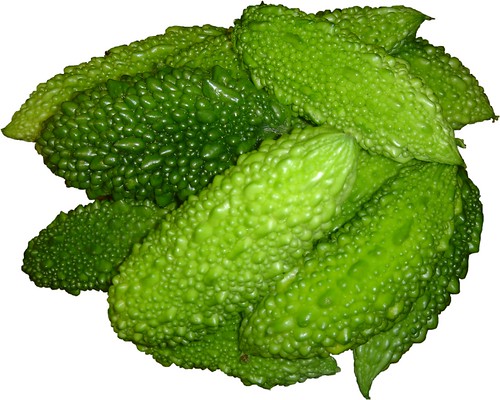
Since vegetarians who stay in Tokyo for a longer time will surely not be able to eat out in the few but fancy veggie restaurants every day and some (like me) might also love to rummage local supermarkets and do some experimental cooking, I will present some of the vegetables that are worth to be explored here from time to time. The first one will be Goya - bitter melon (aka bitter gourd). It is an Okinawan speciality and I heard and read that it might be the reason for the longevity of the Okinawans. The other theory is that the extremely strong sake that is so very popular on the southern islands "preserves" the people and let them live long.. However, to clarify this myth is not my intention, but to introduce this healthy and as you can tell by its English name bitter vegetable.
Yes, I know bitter is not quite everyones favorite taste. Most people love sweet or savory, some people still like sour or spicy, but when it comes to bitter there are not many left who think that's mouthwatering.
Except for coffee and maybe grapefruits I can't think of anything bitter to be found in a regular German kitchen. In Japan this is a little different: Matcha, the finest of all green teas, is not only bitter, but also omnipresent, as a drink as well as in chocolate, icecream, pretzels (yesh!), mixed with salt to dip in vegetables, etc.
And there is Goya! And now in the summer month this healthy vegetable, that is high in Vitamin C, is in season and its bitterness is also considered to be refreshing in the heat.
The most famous and popular recipe for it from Okinawa is Goya Champuru. Here in Tokyo it is sometimes served at Okinawan-style izakayas as a snack you have with your drink. Unfortunatly there it comes with pork in it usually, if you can't convince the waiter to bring you one without. I cooked a nice'n'easy veggie version of Goya Champuru at home and had it with rice, but I can also imagine that it is quite nice with some fresh baguette.. for the breadlovers among us.

Here is the recipe, give it a try:

1 Goya
1 tofu
1-2 eggs
1 clove of garlic
sesame oil
brown sugar, soysauce and pepper

wash and cut the Goya lengthwise, scoop out the soft inner part with the seeds

slice the Goya thinly and fry it with the finely chopped garlic in the sesame oil, deglaze it with a little sweet soysauce or sprinkle some brown sugar on in to milden the bitterness
after 1 minute or so add a some water or veggie stock, but not more than half a cup and let it simmer for a few minutes

meanwhile mash tofu and mix with the egg (you can also cut the Tofu in cubes, like on the photo - but I prefer the "scrambled tofu-egg" variant)and add some soysauce and pepper

add to the Goya in the pan or wok and let it all simmer until the egg congeals

and then: enjoy your meal!

The taste of Goya is considered to be an acquired taste, so maybe it won't be love on the first bite, but don't give up so easily. And don't get distracted by its look... I know a cucumber with heavy acne might not be that appealing, but it is good, believe me ;D

Onigiri


The famous triangular- or wheel-shaped rice balls called Onigiri are something that can be found everywhere and anytime in Tokyo. People eat them for breakfast, kids take them to school in their Obento boxes, they are the salariman's favourite for lunch break and a good midnight snack available at the conbini around the corner. Although they look pretty small, they are quite filling due to the big amount of rice that is pressed into the ball shape.
And the good thing about it: many Onigiri are vegetarian! Basically they are made out of freshly cooked Japanese-style rice, a little salt and Nori seaweed plus a wide variety of fillings. The most traditional one would be a pickled plum called Umeboshi (look out for 梅干 or 梅ぼし und you will get this vegan snack) which is extraordinary popular not only with patriots who see the Japanese flag in the red round plum surrounded by white rice. Umeboshi are also said to be very healthy despite their extreme saltiness. Most people are irritated by the salty sour little fruit when they eat it for the first time, but it is indeed a delicassy worth a second try. I love it!
Other vegetarian options are for example Onigiri sprinkled with black sesame or Shiso (紫蘇 or しそ), in English often referred to as Perilla - a dark red herb with a very fresh and distinct flavour.
Another variation is an Onigiri that consists of rice that is mixed with black beans - these are usually not wrapped in seaweed. But with these you have to look out, sometimes they are flavoured with Dashi, that might not be vegetarian! A closer look on the list of ingrediences (if you buy it in a conbini and are able to read Japanese) has to be made if you want to be sure.
You can also buy Onigiri in one of the countless shops, commonly found at train stations. Here they are made freshly and most of the times are offered beside an array of other Obento specialities. These often taste better, but there is no list of ingrediences and you will have to ask whether it is vegetarian or not (unless you take the Umeboshi version that is vegan for sure). But even a positive answer is not at all an assurance of an animalfree rice ball.. The one you see on my photo above looked great: wrapped in spinach (?or something similar?) instead of seaweed, a variant I never saw before that woke my interest. So I asked at the counter in Japanese "is it vegetarian? without meat, without fish?", the vendor said "yes bejitarian", I took it, bit into it - the filling was Katsuobushi, fish flakes! When will it finally become known that fish is still fish even though it does not look like it anymore... and that it won't become more vegetarian by processing it to flakes!
Well, next time I will go on the safe side, have Umeboshi again or buy it at one of the organic food stores that spring up like mushrooms in some areas of the city. Here at least the shop assistants understand the meaning of the word "bejitarian".

Making Onigiri yourself is of course the safest way. You can find a recipe here.