Showing posts with label recipe. Show all posts

"Moonshine" Umeshu

During my stay in Japan I got to taste some wonderful Umeshu, homemade by a nice Obachan with Ume plums from her garden. Usually I am not very enthusiastic about sweet liqueurs, but that was something special: smooth, with an intense but natural plum flavour and not too sweet. The plums were still swimming in the liqueur and they tasted great, especially with some vanilla icecream ;)
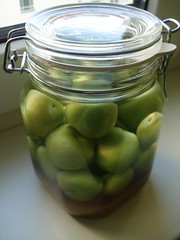
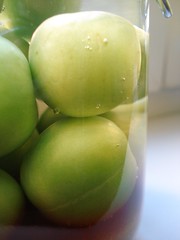
Back home in Berlin, I recently found green, unripe plums (or mirabelles?) called "Can Erik" at a Turkish vegetable store. They looked pretty much like the Japanese Ume used for Umeshu. So I gave it a try, bought a bag full of the plums, brown sugar and a bottle of Japanese Sake (couldn't find any Shochu unfortunately) and a big jar and headed home to attempt my first steps of "moonshining". (Hehe, not really, since I didn't distill the Sake by myself - however, I like the idea ;)...)


First of all I cleaned the plums and the jar thoroughly with hot water. Then I wiped the plums with a towel and placed them in the jar. I filled in about 750g of brown sugar


and 1 liter of Sake,


closed the jar,


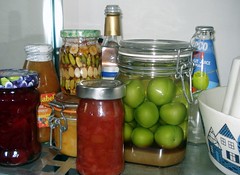
put it on my shelf


and now I have to wait for at least 3 month (better: 1 year!) until I find out whether it tastes right or not.. I just hope it works with Sake, since Shochu, the alcohol that is usually used for Umeshu is much stronger.
We'll see.. I'll keep you updated.
Till then: Kampai!

Go and Gather Your Spring Dish!


If you happen to be at the Japanese countryside and you have a friendly Japanese (maybe elderly) neighbour or acquaintance - it is well worth to ask them to advise you which of the plants around you are edible. There are so many wild greens, or mountain vegetables (山菜 sansai)as they are called in Japanese, that used to be a staple for the rural poor, as well as a delicacy in the refined Japanese cuisine. Today many young city dwellers only know these green goodies as Tempura on their plates in fancy restaurants or as the ingredient of Sansai Soba soups and the like, but often they have no idea how and where those plants grow and how to prepare them.
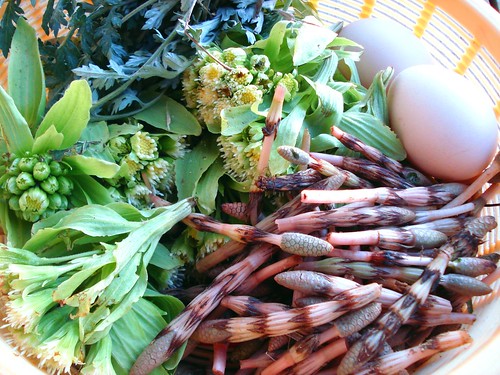
This is a pity since it is so much fun, healthy and for free to go out and gather fresh greens in the mountains and forests of Japan! However what most people luckily still know is, when something is in season. And now it is the season for Tsukushi, Fukinotou and Taranome.
Last spring I found all of these on the premises of the little farm in Ibaraki prefecture where I worked at.
With eggs kindly donated by our chicken, brown rice and a few condiments they became some of the most delightful homemade meals of my life.

Here are the details:
Tsukushi (horse tail)
You can find lots and lots of Tsukushi sprouts on meadows and at riversides approximatly around the time of the first Sakura blossoms. They look like this [click!].
Only take the young ones which did not yet "open their heads" and cut them shortly above the ground, so that you have stem and head.
Rinse them thoroughly and remove the outer shells (hakama) that look like little crowns. You may cut the Tsukushi to about 15mm long pieces. Then soak the Tsukushi with a little soysauce, Mirin and a pinch of salt for about 30min.
In the meantime wash the rice and put it in the rice cooker with an equal amount of water. Then just add the Tsukushi together with the soysauce-Mirin-mixture and let it all cook until the rice is soft and all the water is gone. The Tsukushi should also be soft and nice now.
You can make Tsukushi Onigiri out of it or use this Tsukushi Gohan (rice dish) as a very fine complement on Tempura for example.


Fukinotou
Fukinotou is a rather unimpressive looking short pale yellow flower with lots of green leaves, often growing on meadows in the shade of trees or bushes. They look like this [click!]. It is best to harvest them before they are in full bloom, because they tend to be a little bitter, and the longer they bloom the more bitter they get.
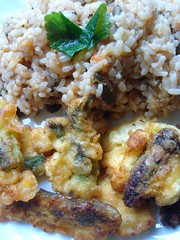
The most popular way to eat Fukinotou is in form of Tempura. The batter and the frying process takes away a bit of the bitternes, resulting in just the right balance of the taste of the fresh and flowerly green and the rich yet fluffily batter.
I confess that I used a ready-made Tempura mixture (containing flour, starch, baking powder and salt in the right proportions) and I just had to add egg and cold water and stir it a few seconds with chopsticks - very easy!
After washing and draining the Fukinotou, I dipped them in the batter and then fried them quickly in hot oil. Drain the fried Fukinotou Tempura again to get rid of the excessive oil and then serve it still hot with the Tsukushi Gohan.


Taranome (buds of Aralia)
Taranome are the buds of a very thorny bush and look like this [click!]. It is also better to harvest them early, before the grow too big, hard and woody.
They are also really delicious as Tempura.


The other greens on the first big photo above are Yomogi (mugwort) leaves. This weed grows all over Honshu in a rather epidemic way and most Japanese homegardeners hate it! However it has a nice and fresh herbal taste and is very healthy, so please try the recipe I posted before or chop it and sprinkle it on a salad, tomato salad for example. Yummy!

For more recipes and additional infos in English I recommend reading the interesting blog article.

Comatose Cupcakes

Wow, I definitely gonna try this recipe: Kurogoma Cupcakes with Matcha Cream Cheese Frosting!
MMMMMHHHHHHHH :)

Update: I tried this recipe last week and the cupcakes turned out lovely although I didn't have any black sesame paste at hand. I also took much less sugar (just about 220g) and they were still sweet enough for my taste.
Here they are:

A veggie pre-christmas time!

Uuuh, sorry, I didn't write here for such a long time in spite of some recommendations I still want to pass on to you.. I returned to Germany in the meantime and was busy with all kind of other things and concentrated on writing on my Berlin restaurant blog (I also changed its design, do you like it?).
However I haven't forgotten you guys!
One of my primary aims with this blog was and still is to show you that you are not lost and alone in Japan as a vegetarian. There are lots of people around you who also love their veggies. A true lover of vegetables (and music) can be found here:


^___^

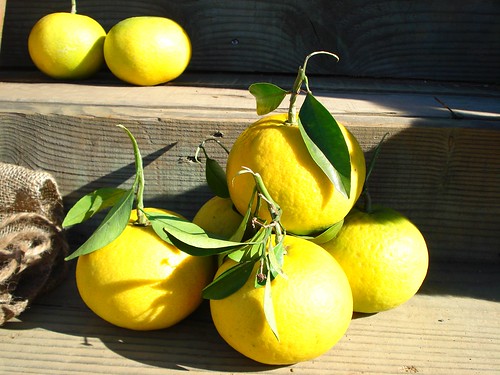
Okay, no more kidding. One thing I really loved in Japan at this time of the year are all the wonderful citrus fruits I've never seen somewhere else before. My favourite is Yuzu, a fruit that is not that good for eating raw just like it is, but Yuzu juice and Yuzu zest are great ingrediences for various dishes. It has an indescribably aromatic and intense scent that goes along fine with boiled tofu, udon noodles, gives soups and sauces a fresh touch, can be found in dried spice mixtures with chili and black sesame, as well as in form of Yuzu Koshou (literally Yuzu pepper) - a spicy flavouring that can be found in Japanese supermarkets and delicatessen shops. Yuzu is also fantastic in sweets like icecream, Yuzu Melon pan, as a hot tea in wintertime, lemonade in summer, or you can make your own Yuzu marmelade!
I did this last winter, alongside several jars of Natsumikan marmelade (another Japanese citrus fruit, that looks a bit like a big yellow orange or grapefruit, but has a milder taste.


All those fruits grow during the summertime (Natsumikan means "summer tangerine")but are very often not harvested since they looks so pretty on the trees in winter. When the weather tends to get gray it is nice to have some bright coloured dots on the trees :) However, if you happen to be on the Japanese countryside or are lucky enough to have such a tree somewhere close-by, you should try to get your hands on some of the fruits before they start to rot. They are just too delicious for not being eaten!

For making marmelade: squeeze as much juice as you can get out of the fruits, add some zests (not too much though - it could turn bitter otherwise) and boil with an equal amount of sugar for at least 15 - 20 min. Even better would be jam sugar since you only need half as much sugar and a shorter cooking time thanks to the pectin that is added. However I couldn't find any jam sugar in Japan unfortunatly.
To check if it is ready put a teaspoon of the marmelade on a little plate, keep it on a cool place for two minutes to see if the marmelade thickens when it cools. If not cook it a little longer and try again.
If it doesn't get firm like marmelades bought in shops, don't worry: the taste will be great anyway and you can also try stiring it in yoghurt for example or as yummie topping on vanilla icecream..

Yomogi Pesto


Since I spend some time on the countryside at the moment, working at a holidayplace with a little farm, I get lots of fresh, local foods. I have some chicken here, that lay an egg for me from time to time, which I really appreciate a lot. There is a chestnut tree in the garden and although I feed most of the chestnuts to the horses, there are still a few also for me.
Unfortunatly Akebi season is over, but at least I had some of this strange but healthy and sweet fruits when I first came here.
In the last days I cooked a different dish every day with the huge squash/pumpkin (whatever it was exactly.. I don't know! It was dark green outside, whitish light green inside with lots of seeds and it was bigger than a basketball) that we got for free from farmers around and I still have some of the fantastic home-pickeled umeboshi some ladies gave us as a present...
And today I thought about doing something with the forest of Yomogi (mugwort) that is growing all over the yard. Since I don't have an oven here, I can't bake Yomogi Pan, I have no idea how to make Yomogi Mochi and Yomogi Udon were a little too much work for me today. So I made something simple and quick yet delicious: Yomogi Pesto!
I took a handful of Yomogi leaves, washed and chopped them finely. Then I mixed them with 2 big cloves of garlic that I had mashed and added a fair amount of seasalt, sesame oil, a few spoons of kinako
(which came quite handy as a subsitude for ground nuts, that I didn't have here) and a little black pepper.


I tried some of this with the squash risotto I had for lunch, just about half an hour after I made it and it tasted pretty good already. However it became even better after a few hours in the fridge, when it was really soaked and the oil is full of the fragance of the herbs. The next day I had it with pasta and it was fantastic! Such a fresh and intensive taste! Wonderful!
Another favourite of mine are the combined flavours of Yomogi Pesto and potatoes... mmmh, just a little bit of the Pesto with roast potatoes makes such a simple dish so delicate.
Don't hesitate, eat the weed and be happy ;)

Okara


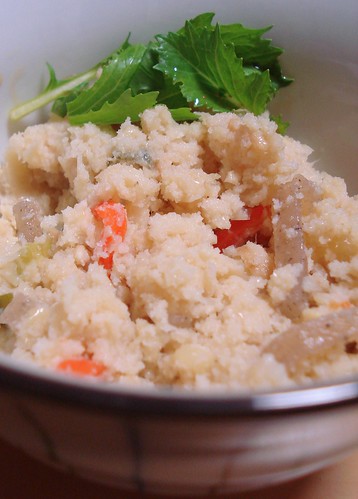
Have you ever wondered where all the soy pulp ends that is left over when producing soy milk, Tofu and the likes? No? Don't worry, most people don't, I guess. This surely is due to the fact that most of this highly nutritious stuff is used to feed up animals, especially pigs as far as I know. But actually there is no reason why humans shouldn't eat this healthy soy mash, too. And by the way: vegetarians have to hear so many "jokes" like "you eat away the food for the birds/cows etc.." - so why not doing it! I love Müsli, lettuce and yes, also Okara (that is how the soy pulp is called in Japan). Here and in Korea and China people always ate it and they are right: it "is low in fat, high in fiber, and also contains protein, calcium, iron, and riboflavin." (says Wikipedia). And it can be the basis for a tasty dish! It does not have a very rich flavour by itself, rather mild and a bit bland, but you this gives way for so many possibilities.
Here in Japan you often find Okara flavoured with Mirin, carrots, Konnyaku and some spring onions, as a snack that is thought to taste good with beer. You can find it freshly packed like this in the supermarket or you can get it in Izakayas also. I don't like beer, however that doesn't keep me from loving all those savoury snacks that are served with it.
Sometimes they also have Okara in its plain form in the Tofu corner of the refrigerator section in supermarkets. Although the ready-to-eat-versions are convenient, I think they are often too sweet and so it usually tastes much better if you can get the plain stuff and spice it up yourself. You can do that the traditional way with the condiments I mentioned above and eat it cold.
Or you can use it for example to bake vegan cakes (i've never tried to make that, but I heard it works out very fine, see a picture here). Or you can make very tasty vegetarian patties. I mixed an egg with the Okara, some shredded carrots, salt, pepper and garlic and a little flour, formed patties and fried them. Utterly delicous! Especially with my favourite hotsauce that was sent to me all the way from Barbados as a present recently :)


*thanks again!
I just love the flavour of Scotch Bonnett Peppers and mustard and of course it is spicy hot like hell and gives me an immediate hick-up, but that is part of the fun!

Vegetarian Okonomiyaki


Okonomiyaki is a typical festival food in Japan - at every Omatsuri you can be sure to find at least one or two okonomiyaki stalls (except for the Namaste India festival and the Vegetarian Culture Fair maybe..). Osaka is famous for this dish that consist mainly of shredded cabbage and a pancake-like batter, spiced up with beni shôga, pickled red ginger, all fried on a hot plate and topped with a special dark brown sauce and oftentimes mayonnaise. The version from Hiroshima contains fried soba and the ingrediences are not mixed up, but first the batter is fried to something like a pancake and than the other ingrediences are all piled up on it to one tower of okonomiyaki that shrinks during the frying but it still looks like an artistic feat to turn it over..
Unfortunatly the usual okonomiyaki is not vegetarian, but made with fish-based dashi (stock), often with those tiny kind of shrimps and topped with my friends the katsuobushi (fishflakes)..
Actually it would be no problem to leave those little beasts out, but as it often is in Japan you make people very uneasy if you ask to modify a traditional, original, century old recipe even the slightest little bit. It seems to be a sacrilege, impossible because the dish is just perfect as it is - I don't dare to doubt that, but I prefer an imperfect veggie dish to a perfect one with dead animals in it. Usually it still tastes great and for me personally it tastes better when there are no little sad eyes staring at me from my plate!
But it seems like there is no way to make it any different, although the name okonomiyaki implies "fry whatever you want"... Well, yet there is a way: just do it yourself! A few days ago I was invited for a fantastic, homemade, vegetarian okonomiyaki and monja dinner - and a feast it was! Monja (also called monjayaki) is the softer, more liquid and mushy sister of okonomiyaki - a dish originating from Tokyo, to be eaten directly from the hot plate it is fried on, for example in one of the countless monja places in shitamachi. There you also should be able to find veggie versions, but it is also easy to make it at home - you only need a hot plate. There are special ones for okonomiyaki (and monja), but I think it should also work on those hot plates on top of raclette ovens, maybe even in a good not-sticking pan. Although making it in a pan is not an ideal solution, cause the sociable, comfortable and fun aspect of sitting around the hot plate waiting for the next piece of food and watching the batter sizzle. You can easily spent two hours eating like that - nice!
Now to the recipes. I don't know exact measurements, but I think it is a dish that does not require exact measurements. Just try to fry one okonomiyaki and if it is too soggy add some more flour before you fry the next one or add more stock if you think it is too dry - easy as that.
Okonomiyaki:
Cut about half of a cabbage in thin slices.
Mix about 3 cups of flour with 1-2 eggs and some veggie stock (less than 1 cup should be enough), add a little salt.
Mix the cabbage and the batter and add as much beni shôga as you like (don't take too much, otherwise you won't taste anything else anymore).


Now you can add whatever you like, for example: thinly sliced shiitake, okra, green asparagus, onions or leek, pieces of mochi (sticky not-sweetened ricecakes), corn, even cheese is not unusual and tastes fantastic with it.. Our okonomiyaki-host also added Agedama (also called Tenkasu), that is something resembling the German "Backerbsen" (are they called soup pearls in English? Until that night I didn't know they exist outside of Germany).
Than fry a big spoon of it on the hot plate with very little oil and turn it over when it is still soft on top but golden brown on the underside and fry it on the other side for a short time.


Afterwards top it with a thick and sweet soy sauce (since okonomiyaki sauce is usually with oyster extract and worcestershire sauce, that resembles it a lot contains anchovies as far as I know), mayonnaise (if you like it - I hate mayonnaise so I don't use it), sprinkle with aonori (dried seaweed). Part it in four pieces with a wooden spatula and serve hot. While eating the next serving is put on the hot plate.


For making monja you make the same batter, just add much more water or veggie stock and grated yam and stir it a bit longer. Then put the cabbage and whatever you want to have with it (I recommend asparagus and cheese) on the hot plate and let it stir-fry for a moment, make a hole in the middle and add the batter. Then everyone spreads out bitsized pieces of it thinly with a wooden spatula, so that those pieces become brown, a bit gumlike and crispy on the edges - these portions are to be eaten directly from the hot plate with chopsticks. Here and here you can see pictures of monja.
Have a nice meal, share it with friends and enjoy a great foody-night, like I did - thanks again Nishi-san and Yuko-san :)
Tofu Sômen


Today was a bright and sunny summerday! It seems like Tsuyu, the rainy season is finally over! It was very hot outside, but clear and not that humid anymore. It really felt like summer!
So what to eat for dinner on a summer evening? Something light and refreshing! How about Tofu Somen, a new favourite of mine, since I found it in my local supermarket just about two weeks ago. This dish looks like very thin noodles (sômen), but actually these "noodles" are made out of tofu. Traditionally they are eaten chilled with tsuyu-sauce - but this is often made with bonitoflakes(katsuobushi - my nightmare, see my first posting here), so we better take light soysauce and add a little mirin. I also like to put some salad on top- for example tomato-cucumber-nira sprinkled with lemonjuice, sesame oil and black pepper. Although this might not be very authentic, when it is hot I am often starving for salads and fresh, raw vegetables and fruits. I don't care about recipes, I just care about the taste! However, just a little finely chopped myoga and sesame on top of the Tofu Somen also tastes great, for all the purists among you ;)
You can find Tofu Soumen in the refrigarated section of Japanese supermarkets, where it usually is ready-packed with the matching tsuyu-sauce (which might not be vegetarian, as I said before). No cooking is required - just drain the Tofu Somen a little, put them in a bowl and pour the sauce over them. This is just the most perfect thing to eat - fresh, tasty, light, healthy, vegetarian - super easy to prepare for a lazy evening after a hot day!
There are so many wonderful things to find in the huge tofu section of Japanese supermarkets - and most of them are the general vegetarian's friends. You just have to go there and take them home ;)

PS: If you like it a bit more elaborate or are searching for a good idea for the next garden party, try "flowing somen"! Looks like fun!

Goya


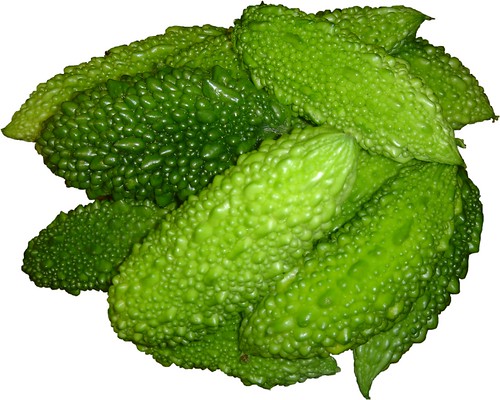
Since vegetarians who stay in Tokyo for a longer time will surely not be able to eat out in the few but fancy veggie restaurants every day and some (like me) might also love to rummage local supermarkets and do some experimental cooking, I will present some of the vegetables that are worth to be explored here from time to time. The first one will be Goya - bitter melon (aka bitter gourd). It is an Okinawan speciality and I heard and read that it might be the reason for the longevity of the Okinawans. The other theory is that the extremely strong sake that is so very popular on the southern islands "preserves" the people and let them live long.. However, to clarify this myth is not my intention, but to introduce this healthy and as you can tell by its English name bitter vegetable.
Yes, I know bitter is not quite everyones favorite taste. Most people love sweet or savory, some people still like sour or spicy, but when it comes to bitter there are not many left who think that's mouthwatering.
Except for coffee and maybe grapefruits I can't think of anything bitter to be found in a regular German kitchen. In Japan this is a little different: Matcha, the finest of all green teas, is not only bitter, but also omnipresent, as a drink as well as in chocolate, icecream, pretzels (yesh!), mixed with salt to dip in vegetables, etc.
And there is Goya! And now in the summer month this healthy vegetable, that is high in Vitamin C, is in season and its bitterness is also considered to be refreshing in the heat.
The most famous and popular recipe for it from Okinawa is Goya Champuru. Here in Tokyo it is sometimes served at Okinawan-style izakayas as a snack you have with your drink. Unfortunatly there it comes with pork in it usually, if you can't convince the waiter to bring you one without. I cooked a nice'n'easy veggie version of Goya Champuru at home and had it with rice, but I can also imagine that it is quite nice with some fresh baguette.. for the breadlovers among us.

Here is the recipe, give it a try:

1 Goya
1 tofu
1-2 eggs
1 clove of garlic
sesame oil
brown sugar, soysauce and pepper

wash and cut the Goya lengthwise, scoop out the soft inner part with the seeds

slice the Goya thinly and fry it with the finely chopped garlic in the sesame oil, deglaze it with a little sweet soysauce or sprinkle some brown sugar on in to milden the bitterness
after 1 minute or so add a some water or veggie stock, but not more than half a cup and let it simmer for a few minutes

meanwhile mash tofu and mix with the egg (you can also cut the Tofu in cubes, like on the photo - but I prefer the "scrambled tofu-egg" variant)and add some soysauce and pepper

add to the Goya in the pan or wok and let it all simmer until the egg congeals

and then: enjoy your meal!

The taste of Goya is considered to be an acquired taste, so maybe it won't be love on the first bite, but don't give up so easily. And don't get distracted by its look... I know a cucumber with heavy acne might not be that appealing, but it is good, believe me ;D